
Aesthetic Value of the Landscape
OV7 Valued Landscapes
OV8 Dark Skies
OV7 Valued Landscapes
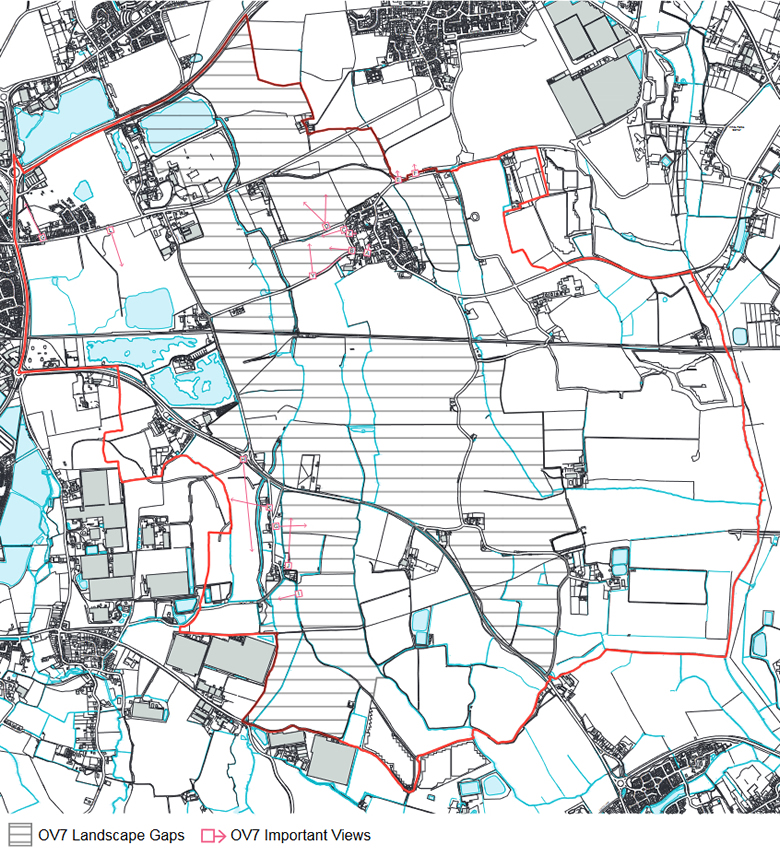
A. The Neighbourhood Plan defines several Landscape Gaps, as shown on the Policies Map, for the spatial purpose of preventing the visual coalescence of settlements within and adjoining the Parish:
i. Shopwyke and Oving
ii. Tangmere and Shopwyke
iii Tangmere and Oving
iv Bersted and Chichester
v Runcton and Bersted
vi Bersted and Oving
Development proposals that lie within a defined Local Gap must be located and designed in such a way as to prevent the visual coalescence of the settlements.
B. The Neighbourhood Plan identifies Important Views, as illustrated in the Design
Code and as shown on the Policies Map. Development proposals that are located
within or immediately adjoining an Important View will only be supported if it
can be demonstrated that the key features of the view can continue to be enjoyed
including views of Chichester Cathedral, views to and from South Downs National
Park, areas of landscape and the juxtaposition of the village edge and surrounding
countryside.
Local Planning Policy Context
Policy OV7 accords with Chichester Local Plan 2014-2029 policy 48 and emerging
Chichester Local Plan 2021-2039 policy NE2 in seeking to prevent adverse impact on
Important Views identified within the parish. OV7 also accords with emerging Chichester
Local Plan 2021-2039 policy NE3 which offers neighbourhood plans scope to identify the
boundaries of Landscape Gaps.
Reference: Hankinson Duckett Associates. Oving West Sussex Landscape Gap Assessment
for Oving Parish Council. September 2024
OV8 Dark Skies
A All development proposals should be designed to minimise the occurrence of light
pollution. The Parish Council will expect such schemes to employ energy efficient
forms of lighting that also reduce light scatter and comply with the current guidelines
established for rural areas by the Institute of Lighting Professionals (ILP).
B. Proposals for all development will be expected to demonstrate how it is intended
to prevent light pollution. Information on these measures must be submitted with
applications, and where a development would potentially have an impact on light
levels in the area, an appropriate lighting scheme will be secured by planning
condition.
Supporting text
Half of Oving village and the hamlets have never had street lighting installed. As a result,
the undeveloped parts of the parish enjoy relatively low light levels. These enable residents
to appreciate the night sky and the darkened landscape and to control, to a large extent, the
amount of light that illuminates their properties at night. Low light levels are an important
benefit to wildlife because there is minimal disturbance to the regular patterns of nocturnal
insects, birds and mammals.
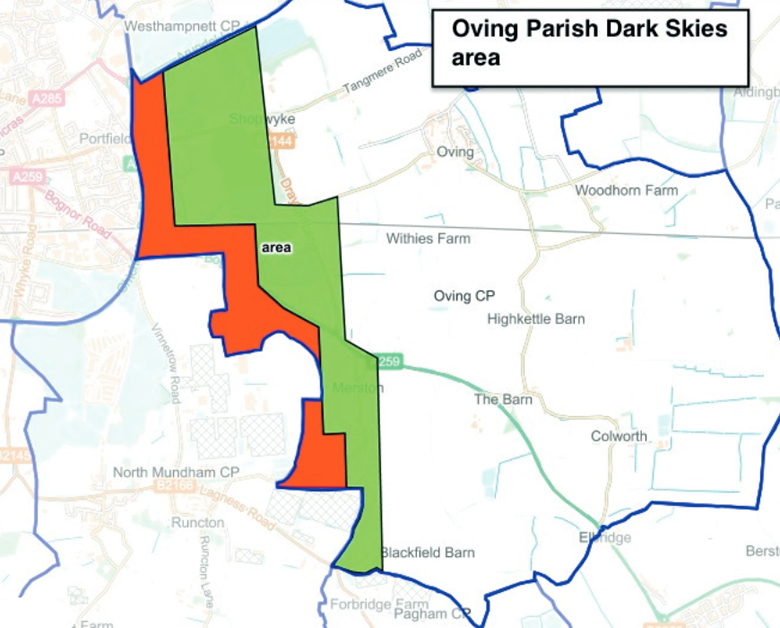
The darkest skies are those farthest from Chichester city, the glasshouses areas in the
Horticultural Development Area and the A27 and A259 corridors. The rest of the parish is
relatively dark (1-4 nano watts/cm2/sr).
It is important that lighting in new developments is strictly controlled especially when it
would affect the quality of listed buildings or Conservation Area, the wildlife corridors or
the setting of the South Downs National Park, an International Dark Sky Reserve.
There are three common sources of light pollution. The first is glow which emanates from
settlements. Sky glow from Chichester and Tangmere is visible in the parish. The second is
glare, which is caused by bright light viewed against darkness. The third is light intrusion
which is light spilling beyond the property being lit. This is most pronounced from
glasshouses where there is not light cover at night.
The use of energy efficient lighting, cowls and careful directional lighting can achieve
considerable benefits. Particular care is required in the design of lighting for some types of
development, for example community buildings and sports pitches, which otherwise can
cause considerable pollution far beyond their immediate boundaries.
Local Planning Policy Context
Policy OV8 accords with emerging Chichester Local Plan 2021-2039 policies NE20 and NE21 in requiring development proposals to consider the impact of their lighting schemes on light pollution.