
Enterprise and Social
OV1 Employment
OV2 New Local Services
OV3 Community Facilities
OV1 Employment
A. Development proposals that enhance the operational effectiveness, efficiency
and appearance of existing employment sites and facilities, or redevelop existing
employment sites to provide modern commercial premises and flexible workspace
will be supported provided:
l. any harmful impacts on residential development and public amenities are avoided or successfully minimised;
ll. it can be demonstrated that any harmful impacts on environment, wildlife, landscape and/ or any heritage assets are clearly outweighed by the economic benefits in line with the designated status of the asset;
lll. the proposals have sought to maximise the use zero carbon energy performance on all new buildings wherever possible;
B. Proposals that will result in the overall loss of employment floorspace will be resisted unless it can be demonstrated that any replacement will achieve a higher employment density and offer a wider range of higher skilled local employment.
C. New Employment sites will be in conformity with the design guide AECOM Oving Design Guidelines and Codes Final Report January 2022 (ODGC)

Introduction/ objective
Oving Parish has 13 employment sites of which the largest is the Glenmore Business Park.
The recently completed Bartholomews site is the next largest. Drayton House, Littlemead
business centre, Shopwyke industrial centre, Woodhorn and Madam Green Farm are the
other principal areas of economic activity.
The remaining sites are characterised by mostly low density, inefficient use of land with low tech, and low value economic activity.
The parish is mainly rural with a significant number of people employed in agriculture and horticulture.
As an overriding principle, priority will be given to building critical mass in the better managed and located centres and not creating new economic space.
Supporting text
If the businesses accommodation and use of land is supportive there would be scope for a
progressive rural economy, eg light engineering, machinery maintenance, technology, waste
management, veterinary services and other businesses that drive improved productivity,
value and average wage growth.
The aim of this policy is to ensure there is no overall loss of existing business or
commercial facilities in the parish and, as a result, no corresponding loss of local
employment. The policy is intended to act as a catalyst for the regeneration of existing
employment land which might serve a more sustainable and higher wage local economy
by encouraging a higher employment density. This in turn will reduce the pressure to find
new employment land on the edge of the urban area.
The policy encourages existing business locations to develop further through a
combination of support for a change of use of existing buildings and increasing
employment density. The policy reflects the district wide evidence of the changing
employment practice that is evident in many areas across the country.
Paragraph 11.38 of the Chichester Housing and Economic Needs Assessment (Jan 2018)
confirms “changing operating practices and increasing levels of automation have meant
that there is a changing relationship between manufacturing jobs and industrial floorspace:
the amount of floorspace required per manufacturing worker (i.e. the employment density)
has been increasing, influenced by productivity improvements.”
The policy supports proposals that enhance the operational site efficiency and provide
an attractive place to work, park and access, especially by cycle. In terms of landscape
sensitivity, it is also acknowledged that locations that are less sensitive in the landscape
are more likely to be near major roads. This includes the area along the A259, from
Bartholomews Agri Food Ltd at the Chichester Food Park to the junction with the A27
Chichester by-pass.
In its contribution to the CDC 2018 edition of Housing and Economic Needs Assessment
Oxford Economics has indicated a maximum need for 32 additional hectares of space for
glass houses/ polytunnels and services in the period to 2035 across the district.
The provisions of policy OV13 should be applied to proposals for buildings and structures over three storeys.
Local Planning Policy Context
Policy OV1 accords with Chichester Local Plan 2014-2029 policies 3, 26 and 38 in respect
of protecting and enhancing existing employment sites and facilities. This is demonstrated
through the requirement that the enhancement or redevelopment of existing facilities
does not have harmful impacts including those on wildlife and landscape. Additionally,
proposals that lead to the loss of employment facility floorspace will have to provide new
or replacement facilities. This accordance also extends to the emerging Chichester Local
Plan 2021-2039 policy E2.
Chichester Housing and Economic Development Needs Assessment (January 2018)
West Sussex 2018-2023 Economic Growth Plan
OV2 New Local Services
Proposals for the development of a village shop (Class F2(a)) and/ or a hall or meeting place for the principal use of the local community (Class F2(b)) will be supported, provided:
l The land is within or adjoins the built up area of Oving village;
ll The scheme meets the specification agreed by the local planning authority and Parish Council for the facility, comprising a building and ancillary outdoor operational space;
lll. A safe and convenient form of highway access is provided
lV. Safe pedestrian and cycle access is made to serve the scheme;
V. The landscape scheme improves the effectiveness of any existing mature vegetation on the site boundaries to screen the scheme from the open countryside and protect the amenity of neighbouring properties.
This policy provides for the development of a village shop and community hub.
There is more than one potential location that may be suited to this use, and hence a criteria-based approach has been adopted.
Local Planning Policy Context
Policy OV2 accords with the emerging Chichester Local Plan 2021-2039 policy E17 by
supporting the development of a village shop and/or hall or meeting place. OV2 also sets
a number of requirements including safe pedestrian and cycle access which reflects policy
E17.
References
Appendix OV2 New Local Services
OV3 Community Facilities
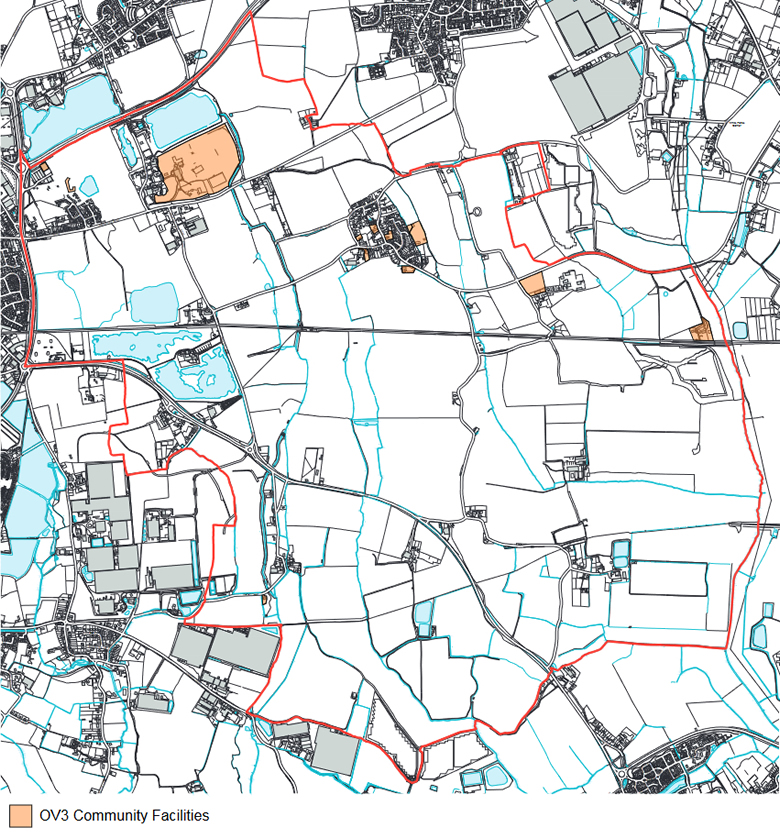
A The Neighbourhood Plan identifies the following community facilities, as shown on the Policies Map:
i. Oving Jubilee Hall
ii. Gribble Inn pub
iii. Flip out centre
iv. Westbourne House School sports facilities
v. Decoy Farm tourist accommodation
vi. Pavilion, Shopwyke
vii. Retail facilities, Longacres House
viii. Shopwyke Lakes/ New Fields
• Bikeshop/Café
• Play ground
• Playground
• Playground
ix. Community Garden and Telephone Kiosk Book swap
x. St Andrew’s Church and Burial Ground
xi. Woodhorn football ground
xii. Diamond Jubilee Park
xiii. St Giles Church, Merston
B. Development proposals which would affect the use of these community facilities will be determined against the provisions of Policy 38 (Local and Community facilities) and Policy 54 (Open Space, Sport and Recreation) of the CLP or successor policies.
C. Proposals to change the use of part of a community facility that is surplus to requirements to provide a village shop or community hub will be supported where they will support the overall viability and importance of the community facility concerned.
D. The comprehensive masterplan for any strategic allocation within the parish to the
east of Chichester will be expected to demonstrate that the masterplan layout locates
the required social infrastructure including a local shop/café/community hub in such
a way to ensure that the existing settlement of Oving and the hamlets can access that
infrastructure safely and securely.
Local Planning Policy Context
Policy OV3 accords with Chichester Local Plan 2014-2029 policies 38 and 54 in seeking to prevent the loss of a number of identified community facilities in the parish. This accordance also extends to the emerging Chichester Local Plan 2021-2039 policy P17.
See Appendix OV3 Community Facilities